For many beauty salon owners, buying a laser machine feels like the natural next step: a premium treatment category, repeat bookings and the possibility of increasing revenue without adding more traditional beauty services.
But a laser is not automatically a profitable investment. The machine itself is only one part of the decision. Demand, operator competence, room availability, compliance, insurance, servicing, marketing and diary capacity all determine whether the investment will work in practice.
So, is buying a laser machine worth it in 2026?
The short answer is yes — but only when your salon has proven demand, the right team and enough financial headroom to operate the service safely while bookings grow. If those elements are not yet in place, a mobile laser service can provide a lower-risk way to test the market before committing to ownership.
Laser services can raise average client value, support repeat appointments, attract new audiences and differentiate a salon’s treatment menu. But potential is not guaranteed profit. A well-used machine can be a productive asset; the same machine standing unused becomes an expensive fixed cost.
The correct question is therefore not simply, “How much can laser treatments earn?” It is:
“How many completed, profitable appointments can my salon realistically generate every month?”
The advertised price of the machine is the most visible cost, but it is rarely the full cost of introducing the service.
Public UK listings in 2026 show professional hair-removal systems ranging from several thousand pounds into the low five figures, while finance guides for larger or multi-technology platforms extend considerably higher. These figures are not directly comparable because specifications, applications, training, warranties and support packages differ. A quotation should always be assessed on the complete package, not the headline price alone.
Before purchasing, include the following in your financial plan.
Decide whether the salon will buy the device outright, use hire purchase, lease the equipment or take another form of business finance. Compare the total amount payable, not only the monthly instalment.
Check what happens at the end of the agreement, whether ownership transfers to you, whether a final payment applies and what restrictions exist if you want to upgrade or sell the equipment.
A price advertised excluding VAT can look significantly lower than the actual cash requirement. Delivery, installation, configuration and initial testing may also be charged separately.
Ask the supplier to confirm in writing exactly what is included.
Owning a machine does not make a salon ready to provide treatments. Operators need appropriate theoretical and practical training for the technology, treatment protocols, consultations, contraindications, patch testing, incident procedures and the specific device being used.
Training also has an opportunity cost: team members may need time away from their normal appointments, and competence must be maintained rather than treated as a one-off certificate.
Cosmetic laser hair removal is generally outside CQC registration in England when it is provided exclusively for cosmetic purposes. However, local authorities may apply their own registration or licensing requirements, and the position can vary by area.
Before launch, check requirements with the council responsible for the salon location and confirm that the proposed treatments, operators and device are covered by suitable professional and public liability insurance.
The UK Medicines and Healthcare products Regulatory Agency also publishes guidance on the safe use of lasers and intense light systems in aesthetic practice. Safety arrangements should be built into the operating model from the start, not added after the machine arrives.
A profitable forecast can quickly change if a device is unavailable. Ask about preventive servicing, response times, engineer availability, replacement equipment, warranty exclusions and the cost of parts or consumables.
You should also have a plan for communicating with clients and protecting cash flow if appointments must be postponed.
The treatment room may need changes to access, layout, electrical supply, ventilation, surfaces, signage, storage or light control. You will also need time between appointments for consultation, preparation, cleaning, documentation and room turnover.
Theoretical appointment capacity is rarely the same as practical capacity.
Consider whether treatments will be delivered by an existing team member, a new employee or a self-employed practitioner. Include salary or contractor costs, National Insurance where applicable, holiday cover, training time and the impact on other services.
If your strongest therapist moves from an already profitable service into laser appointments, the correct calculation must include the revenue displaced from the old diary.
Clients do not book simply because a machine is present. The service needs a launch plan, consultation process, content, paid or organic promotion, follow-up communication and clear positioning.
Marketing should be treated as a continuing cost, especially during the first months when the salon is building awareness and trust.

A simple break-even calculation begins with contribution margin rather than treatment price.
Monthly break-even appointments = total monthly fixed service costs ÷ contribution margin per completed appointment
Contribution margin means the amount remaining from a completed appointment after the variable costs directly connected with delivering it. It is not the full treatment price.
For example, imagine that a salon allocates the following amounts to its laser service each month:
The total monthly cost in this illustrative model is £1,950.
If the average contribution margin is £50 per completed appointment, the salon needs 39 appointments per month to cover those costs. At an £80 contribution margin, it needs approximately 25 appointments.
These are examples, not forecasts. Your real calculation must use your own treatment prices, appointment mix, finance terms, staff costs, cancellation rate and variable costs.
It is also sensible to calculate three versions:
If the investment only works in the strong case, the risk is high. A robust plan should remain manageable even when growth is slower than hoped.
Ownership is more likely to be commercially appropriate when several conditions are already true.
Evidence means more than clients saying that laser sounds interesting. Stronger signals include consultation requests, a waiting list, deposits, previous referral patterns, competitor demand in your area and existing clients who fit the intended treatment profile.
The machine needs enough completed appointments across the year, not only a successful launch month. Consider seasonality, holidays, staff absence and the time required to build repeat bookings.
The business should not depend entirely on one person without a backup. If the only trained operator leaves or becomes unavailable, the machine may stop generating revenue while finance and servicing costs continue.
Even a financed device requires working capital. Marketing, staffing, insurance, room preparation and unexpected downtime can arise before the service reaches break-even.
Do not buy a complex platform merely because it offers many applications. A device is valuable only when the salon can safely market and consistently deliver the treatments clients want.
Pause before purchasing if:
Buying too early does not mean laser is wrong for the salon. It may simply mean the order of decisions is wrong.
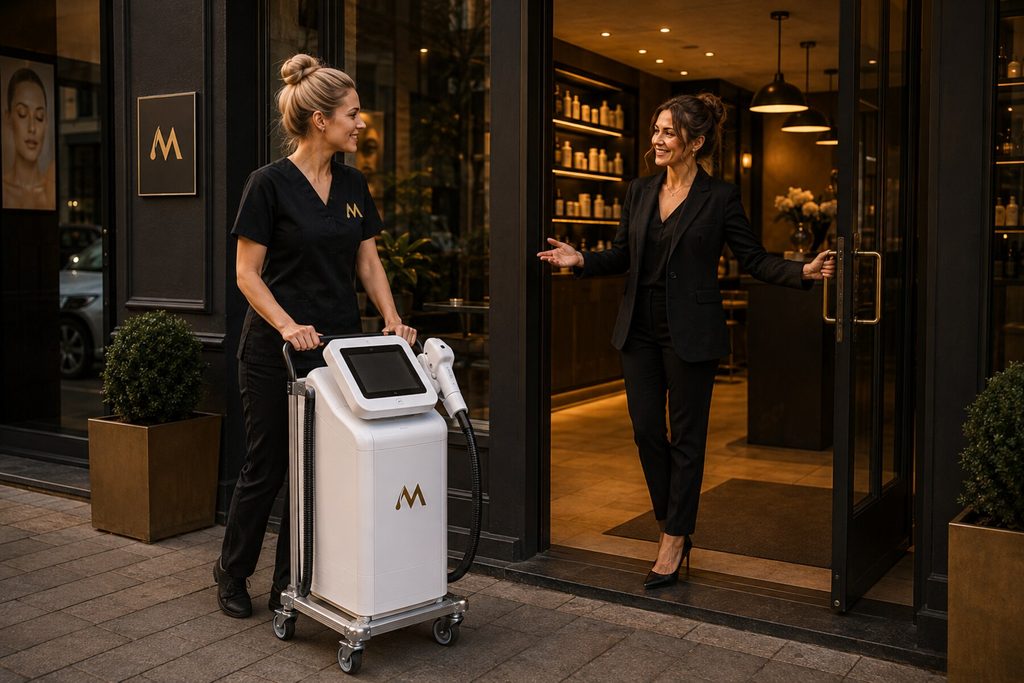
A mobile laser service allows a salon to introduce professional cosmetic laser treatments without purchasing the equipment first.
In the Mobile Laser Therapy UK model, equipment and organisational support are brought to the partner location, while treatments are delivered by trained, independently insured service providers operating on a business-to-business basis. The salon can promote the service, collect bookings and observe real client behaviour before deciding whether ownership is the right long-term step.
This approach can help a salon:
A mobile arrangement is still a commercial relationship and should be evaluated carefully. Ask how revenue is divided, who manages consultations and bookings, what cancellation rules apply, who owns the client relationship, what insurance each party holds and what minimum diary requirements exist.
The advantage is not that the service has no cost. The advantage is that the salon avoids committing capital to an underused asset before it knows whether demand is sustainable.
Buying outright can suit an established salon with proven demand, available capital, trained operators and a long-term plan for the technology. Finance or leasing may protect cash flow, but it creates a recurring commitment and requires careful comparison of total repayment, end-of-term conditions and servicing. Short-term rental can help test equipment, provided responsibility for training, transport, insurance and damage is clear. A mobile service is better suited to salons that want to build demand without purchasing a device or employing a dedicated operator at the beginning.
There is no universally superior model. The best option matches the salon’s current stage, not the stage it hopes to reach immediately.
Before taking on a long-term equipment commitment, run a structured validation period.
Choose a focused treatment range, target client, indicative pricing and consultation pathway. Avoid launching every possible treatment at once.
Promote consultations to existing clients and relevant local audiences. Track enquiries, consultation bookings and deposits separately from likes or comments.
Use an appropriately structured test model to observe completed appointments, treatment mix, cancellations, timing and client questions.
Calculate completed appointments, contribution, rebooking, marketing cost per acquired client and staff time. Compare the results with the break-even requirement for ownership.
At the end of the test, you should be able to answer:
Buying a laser machine can be a strong investment for a beauty salon, but the machine should be the result of a proven business model, not the starting point for one.
If your salon already has sustained demand, a suitable treatment space, trained operators, reliable support and enough financial resilience, ownership may increase control and long-term margin.
If demand is still uncertain, begin by testing the service. A mobile partnership allows you to introduce treatments, gather real booking data and develop client demand before making a larger commitment.
The safest sequence is simple: validate the clients, understand the numbers, then choose the technology and ownership model.
Mobile Laser Therapy UK supports beauty salons with professional mobile cosmetic laser services, equipment and organisational support. Our experience began in Poland in 2008 and expanded to the UK market in 2016.
If you would like to test demand for laser treatments in your salon before purchasing equipment, explore our partnership model:
Partner with Mobile Laser Therapy UK: https://laser-therapy.co.uk/partnership/
Treatments are provided for cosmetic purposes only by independent service providers responsible for their own treatment delivery and professional insurance. Suitability is assessed through consultation, and clients are advised to seek medical advice where appropriate.
Prices vary substantially according to technology, applications, specification, warranty, training and support. Current public UK listings range from several thousand pounds to tens of thousands of pounds. Compare complete written quotations rather than headline prices, and include VAT, training, servicing, insurance, room preparation and finance costs.
There is no universal number. Divide the total monthly cost of operating the service by the average contribution margin from a completed appointment. A salon with £1,950 of monthly costs and a £50 contribution margin would need 39 completed appointments to break even in that illustrative scenario.
In England, providers using laser or IPL exclusively for cosmetic purposes generally do not need CQC registration. Registration may apply where services involve regulated medical activity, and some local councils have separate requirements. Always check the current position for your treatments and location.
Ask for the device specification, VAT status, delivery, installation, training, warranty, servicing, consumables, software or handpiece costs, engineer response times, replacement equipment arrangements and finance terms. Confirm every promise in writing.
Finance may preserve working capital, but it increases the importance of reliable monthly demand. Compare the total payable, deposit, interest, ownership position, early termination conditions and end-of-term payment. Buying outright avoids finance charges but places more capital at risk immediately.
Yes. A salon can work with a professional mobile laser provider that brings equipment and a trained practitioner to the location. The salon should review responsibilities, insurance, booking arrangements, revenue division, client communication and cancellation terms before starting.
Consider ownership when real booking data shows consistent demand, the salon has a trained operator and backup plan, suitable space is available, and the improved margin reasonably outweighs finance, servicing, staffing and downtime risk.